Embodied Science:
Closing the Discovery Loop with Agentic Embodied AI
Current AI4S often remains at static prediction, whereas true breakthroughs emerge from long-horizon, physically grounded experimentation.
Embodied Science reframes discovery as a tight Perception–Language–Action–Discovery (PLAD) loop, where agents perceive instruments, reason over knowledge, execute physical interventions, and internalize outcomes.
Perception
Perception
Raw spectra · instrument logs · statesLanguage
Language
LLM · Sci-KG · tool reasoningAction
Action
Robotic arms · mobile manipulationDiscovery
Discovery
Internalize insights · revise hypothesesPLAD grounds computational reasoning in robust physical feedback, bridging digital prediction and empirical validation across life & chemical sciences.
Paradigm Shift: From Prediction-Centric to Embodied Science
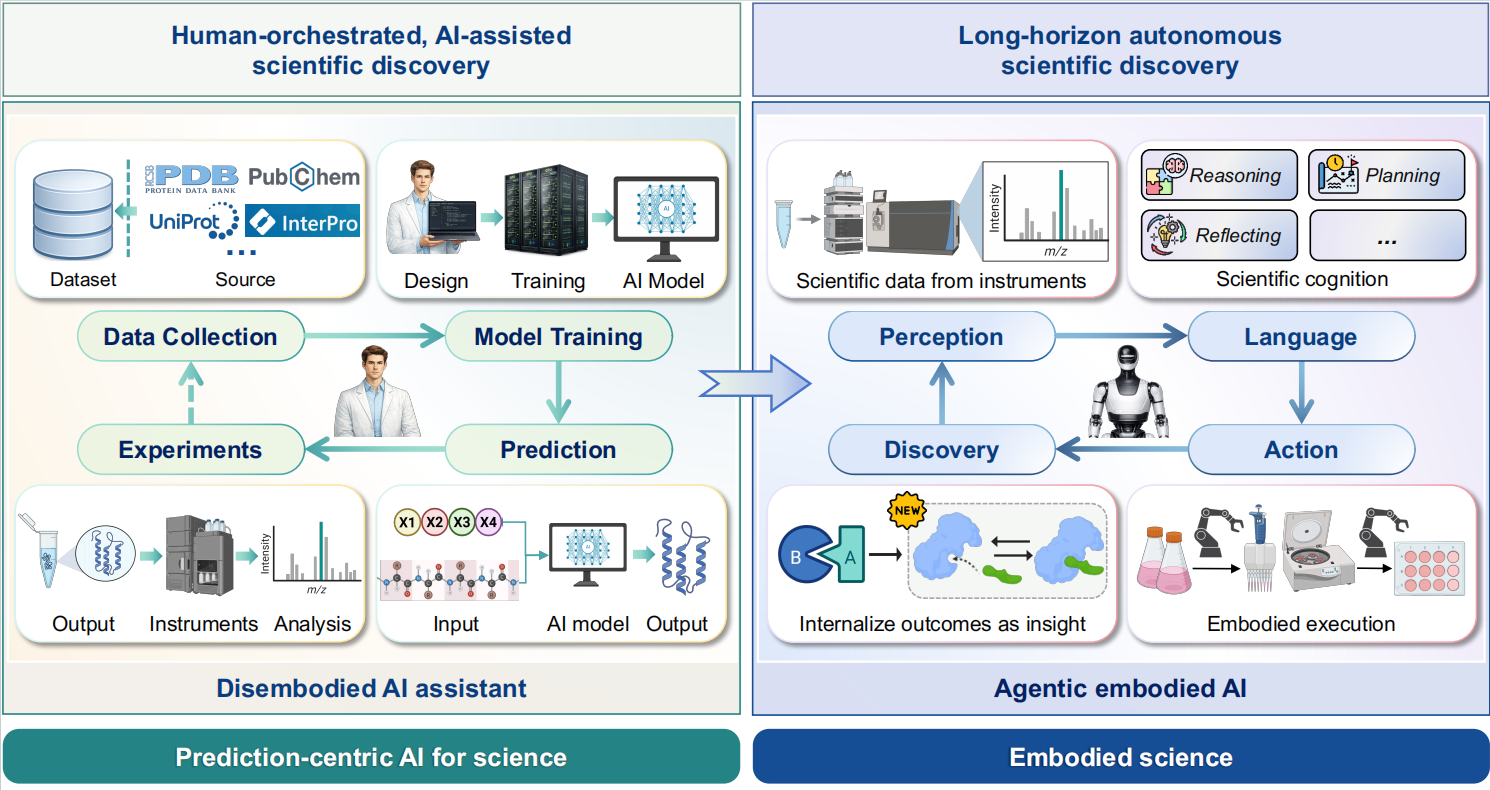
PLAD Framework: Perception · Language · Action · Discovery
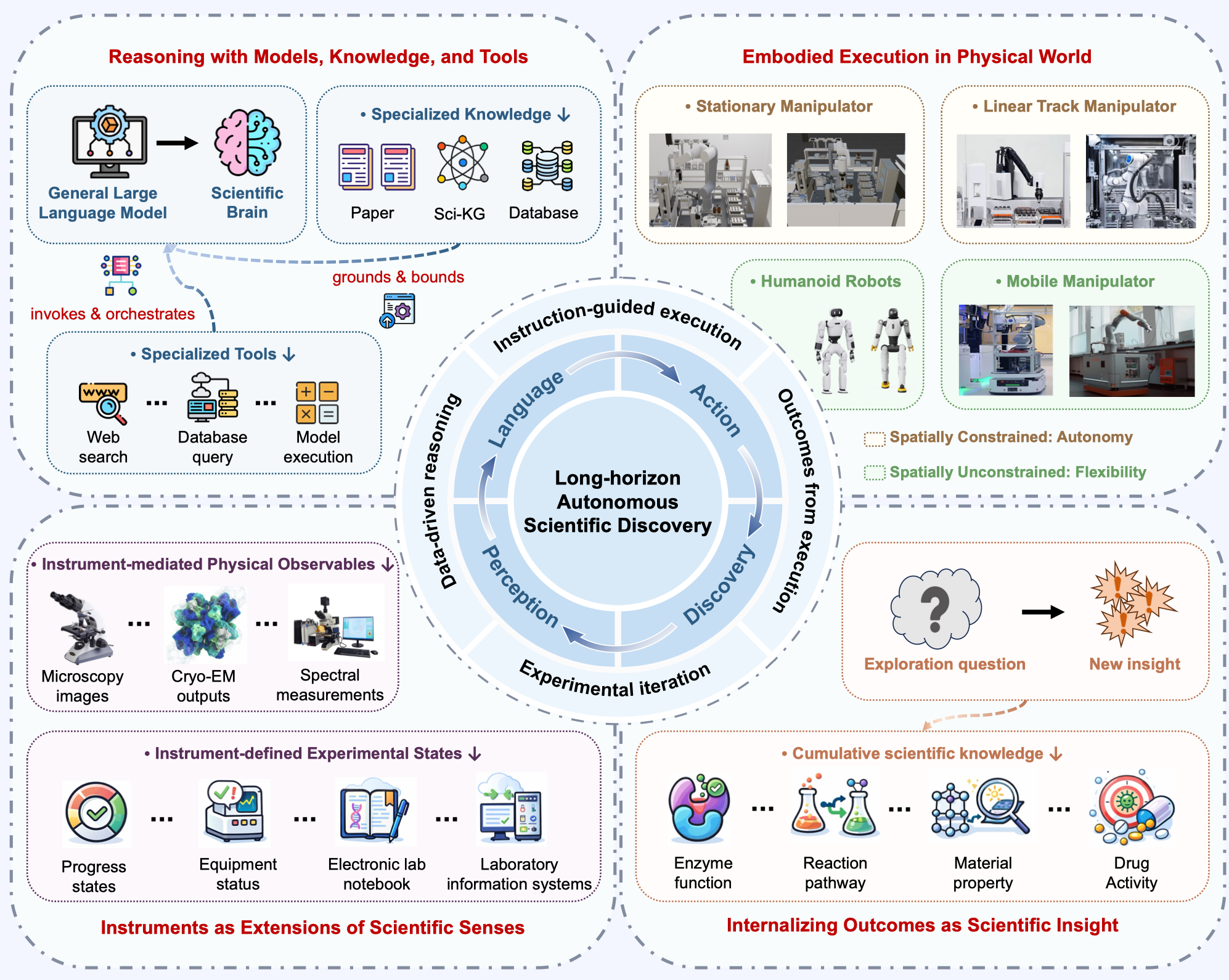
Four integrated modules enabling long-horizon autonomous discovery, moving beyond single-shot predictions to cumulative, transferable scientific insight.
Perception
Instruments as scientific senses — processes raw signals (NMR/MS, microscopy, sensor logs) and experimental states (progress, equipment status). Transforms high-dimensional, noisy data into structured evidence for goal-directed sensing (adaptive recalibration, anomaly-triggered remeasurement).
Language
Scientific brain — foundation models + knowledge graphs (Sci-KG) + tool invocation (RAG, quantum chemistry, MD). Performs mechanism-aware reasoning, counterfactual analysis, and experimental planning, balancing generality with domain precision.
Action
Embodied execution — from stationary manipulators to mobile and humanoid robots. Executes liquid handling, powder weighing, sample transfer, instrument interfacing. Supports multi-step protocols, error recovery, and safety constraints, translating high-level plans into physical interventions.
Discovery
Internalization of scientific insight — abstracts experimental outcomes into transferable knowledge (enzyme design rules, mechanistic constraints). Updates the agent’s internal scientific state, feeding back into subsequent perception & reasoning, enabling cumulative discovery.
PLAD in Action: Enzyme Design & Chemical Reaction Optimization
Enzyme Design
Perception: Cryo-EM, kinetic parameters (Km/kcat), thermal stability.
Language: Infer structure–function relationships, distinguish active-site vs global stability effects; MD simulations & conservation analysis.
Action: Automated library construction, high-throughput screening, mutagenesis.
Discovery: Extract design rules and counterexamples to guide next iteration.
Chemical Reaction Optimization
Perception: In situ IR/NMR, reaction progress curves, byproduct trajectories.
Language: Mechanism-driven reasoning (oxidative addition, reductive elimination). When selectivity drops, hypothesize competing pathways.
Action: Automated flow chemistry or mobile robots execute targeted campaigns to suppress undesired pathways.
Discovery: Derive mechanistic explanations and pathway-level constraints generalizing beyond parameter tuning.
Key Challenges & Design Responses
1. Reasoning over Scientific Data
Complex, noisy signals (LC-MS coelution, isomers) require Sci-LLMs with modality-aware encoders and tool invocation (e.g., deconvolution). Agentic reinforcement learning trains slow thinking and contextual tool use for mechanism-aware interpretation.
2. Embodied Execution Reliability
Heterogeneous robots (fixed/mobile/humanoid) demand sim-to-real transfer. Digital twins modeling heat transfer and fluid dynamics ensure strategies developed in simulation transfer reliably to physical laboratories.
3. Long-Horizon Knowledge Accumulation
Scientific knowledge graphs (Sci-KG) serve as structured memory, integrating hypotheses, failed experiments, and reaction pathways into retrievable, comparable representations, enabling cumulative rather than repetitive discovery.
4. Protocolization of Infrastructure
Science Context Protocol (SCP) standardizes actions, observations, and failure states. Enables agent-interpretable primitives, turning heterogeneous connectivity into composable closed-loop workflows.
5. Safety & Risk Governance
Knowledge-driven hard boundaries (hazardous reagents, T/p limits) plus model-based safety guardrails assess contextual and emergent risks, preventing runaway autonomy and ensuring safe long-horizon exploration.
Toward Autonomous Discovery Systems
“Embodied science is not just an incremental scaling of prediction accuracy; it reframes discovery as an engineered closed loop where agents evolve hypotheses through sustained physical interaction, learning from success, failure, and anomaly.”
— from Embodied Science: Closing the Discovery Loop with Agentic Embodied AI
Read full paper (arXiv 2603.19782)PLAD | Agentic Embodied AI | Closed-loop discovery